- Insights, stories & events
- Bioprocess industry digitalization
Creating benefits by digitalization for the bioprocess industry
6 min read
The bioprocess industry is entering a new era where digitalization, data science, and advanced modeling turn data into actionable knowledge. This shift enables intelligent manufacturing, real-time decision-making, and continuous improvement across both the process chain and the product life cycle.
Projecting digitalization to the bioprocess industry
The bioprocess industry is currently being transformed and disrupted through the capabilities of digitalization and the Internet of Things (IoT), as summarized under the buzzword Industry 4.0. Digitalization in the bioprocess industry creates new forms of innovation and results in new business models: The bioprocess industry is about to go through a revolution by taking full advantage of what innovative digital technologies offer. Industry 4.0 is present in all aspects of the bioprocess industry, as it will have an impact throughout its value chains, from logistics, process- and materials design, planning, plant operations, plant safety, monitoring and maintenance of factory equipment to marketing/sales and supplier/customer integration.
In more detail, digitalization for the bioprocess industry will mainly act on two dimensions: A) the process chain and B) the product life cycle.
The effect of digitalization on the process chain
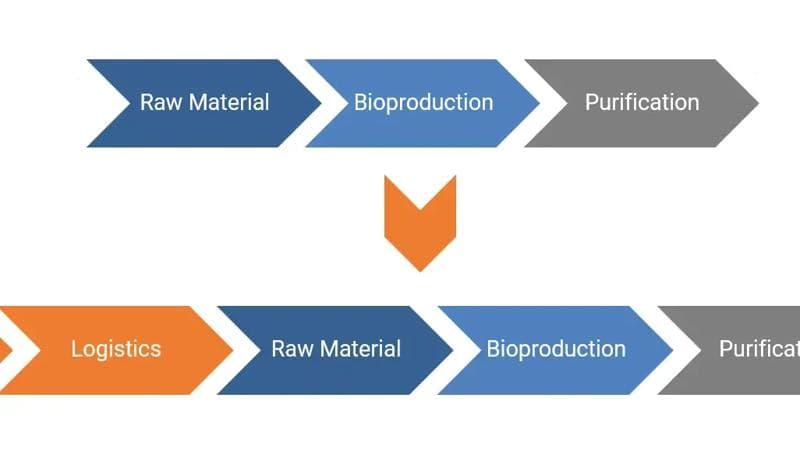
The enhancement of the process chain by digitalization for the bioprocess industry will act on the supply chain, the logistics, and on predictive, rather than preventative, maintenance. There is a strong need to provide solutions to the following tasks/objectives:
- Link manufacturing with peripheral activities
- Develop horizontal analytical techniques (PAT) along the process chain
- Identify process parameters across unit operations and along the process chain.
Identification and data collection of process parameters across all unit operations in product development and operation will enable:
- continuous manufacturing,
- process robust and
- consistent quality.
Digitalization for the bioprocess industry: Effect on the product life cycle
Digitalization for the bioprocess industry covers the complete product life cycle and will lead to flexibilization of production by analyzing sales and basing quick product changeovers on platform knowledge. Both should act on marketing strategies. Hence, the tasks/ objectives are to
- Integrate data from facilities, sites, suppliers, and clients
- Increase process & manufacturing transparency by Quality Metrics
- Allow feedback loops inside of the life cycle for Continuous Improvement
- Create multi-product facilities
- Flexible resource management
- Establish transparent and flexible business process workflows
Software roll-out and implementation strategies have to be carefully considered.
What is the main strategy to achieve this?
No matter which dimension you are working on: The strategy to find the way to a sustainable solution for digitalization for the bioprocess industry is knowledge:
No doubt, enough data is already available. But there is a strong need for generic software tools to generate knowledge. Present tools range from data visualization to data-driven or mechanistic models and provide ontologies and taxonomies.
Models are currently getting increased intention in the bioprocess industry. This is using the next step in the chain, from data over information and knowledge: Intelligence and wisdom. This is a multiparametric control strategy to the objectives mentioned above in technological language, which is applied in a real-time context. The tools here, such as model-based control, model predictive control (MPC), software sensors, is not new, but so far, hardly used in the value-added process industry such as the biopharmaceutical sector. Why not use it so far?
Once knowledge is provided to the process in a real-time context, we must check if the model/knowledge is still valid via knowledge management tools. We need computational model life cycle management (CMLCM) strategies, which are also an integral part of the product life cycle management, enabling feedback loops and continuous improvement of the process chain and product life cycle. This was also strongly emphasized in the recent guidance document ICH Q12 of the regulatory agencies for bioproducts (www.ich.org).
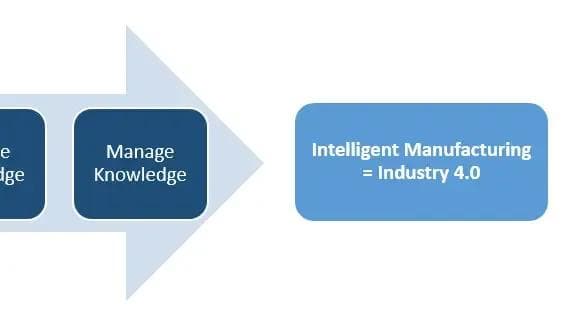
Following the above knowledge-based strategy will lead to intelligent manufacturing, which is worth being named an Industry 4.0 solution. But what is needed, what are the enablers to do so?
What are the key enablers to digitalization for the bioprocess industry?
The key enabler for digitalization for the bioprocess industry is the complete spectrum of data science! Data science strategies are mainly applied in two main sectors, A) in a data management system and B) in a real-time environment.
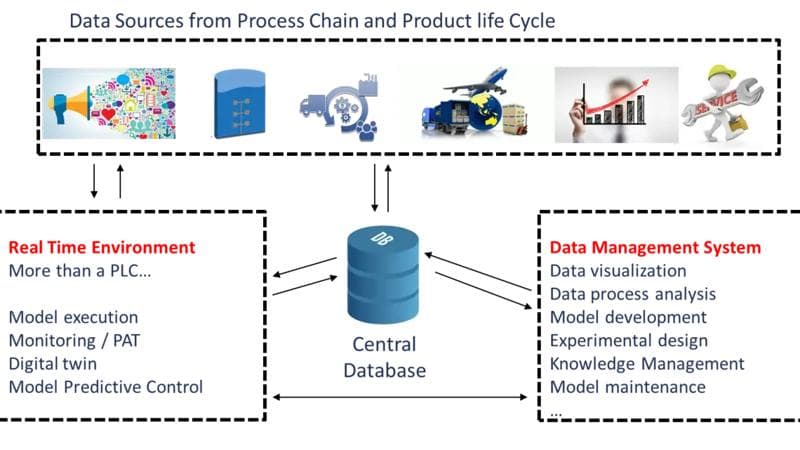
A) Data Management System
- Connectivity: Connectivity of process sensors, but also all other data sources from the process chain and the product life cycle, hence including sales, marketing, maintenance, logistics etc. The data types may vary from metadata, time value pairs to 2D and 3D data. The data needs to be established in a central database, as shown in the following figure.
- Data Contextualization: The data sources may vary in data density and occur at different time points. Data need to be aligned and put into context so that the following steps in data analysis and knowledge gathering can be executed
- Data Analysis: Before data can be analyzed prior knowledge may be entered, and detection of outliers needs to be executed, of course fulfilling the entire spectrum of data integrity. Consider best practices for bioprocess data analytics.
- Model Development, Software Sensors, Knowledge Management, and Model Maintenance: For a sustainable solution, such as being independent of modeling experts, we need full transparency on the procedures: We need automated model building workflows and business process workflows for model maintenance.
Conclusively, there is the need for the models to have predictive power as they are going to be used in a real-time environment.
B) Real-Time Environment
- This system needs to be much more than a Programmable logic controller (PLC), but it may need to be connected!
- Real-time architectures provide correct process information to operators in real-time for decision-making.
- Using Model predictive controls based on multiparametric control strategies, we allow feedback control to detect deviations and automatically adjust operations, decision support, and advanced operator support.
- The system allows real-time execution of a ‘Digital Twin’ (virtual process/plant models) to predict the impact of (design) decisions and anticipate bottlenecks and allow efficient upfront training for new processes and advanced operator support, for example, through augmented reality.
There is a strong need to establish Data Management System (DMS) covering the complete value cycle from process development to production in a real-time environment. Organizations need to implement knowledge management processes and efficiently manage their knowledge within software to become a leader in Industry 4.0.
Get to know our authors

Prof. Dr. Christoph Herwig
Senior Scientific Advisor, Körber Business Area Pharma
Prof. Christoph Herwig was appointed as full professor in biochemical engineering in 2008 returning from a top management position in the biopharmaceutical industry. His research areas include fermentation technology, bioprocess development, and biotechnological production – always bridging scalable bioprocess development to facility design.
You may also be interested in: