Soft Sensor Highlights
- What is a soft sensor (“software sensor” or “softsensor”), and how does it differentiate from a hardware sensor?
- Where can you use soft sensors in industrial bioprocessing?
- How can you measure the biomass concentration in bioprocesses using soft sensors?
- How do you get started with soft sensors in your bioprocessing lab or manufacturing facility?
- How to run soft sensors in Werum
PAS-X Savvy
Soft Sensor Benefits
- Soft sensors make the most out of your data and signals that you have already collected in your bioprocess
- Perform real-time analyzing, monitoring, and control
- Reliant calculation of parameters where no hardware sensor is available
- Reduce purchase and maintenance costs
- Reduce the risk of contamination of the bioreactor
You are a bioprocess professional; you frequently hear and read about “soft sensors,” and you get the idea you should already know about them? But, you keep wondering what people are doing with soft sensors in their locked-up laboratories and manufacturing facilities? Congratulations, this post is for you!
Soft Sensor Definition
The Measurement, Monitoring, Modelling, and Control (M3C), a working group of
ESBES, explains the origin of the name soft sensors:
“The term combines the words “software” because the sensor signal evaluation models are usually implemented in computer programs, and “sensors” because these models are delivering information similar to hardware sensors”.
The key here is “similar to hardware sensors”. It’s what changes this definition from one that could describe almost any form of calculation performed on sensor data. A soft sensor creates a new, hardware-sensor-like signal. However, the signal is produced by a software instead of a hardware sensor. Like every other measurement signal, the soft sensor signal is used to analyze, monitor, and/or control your bioprocesses.
You can distinguish between a soft sensor and a standard calculation on sensor data if you ask yourself the question, “Is this a new hardware sensor-like measurement or just a refinement of a signal I already use?”
At this point, despite this definition and explanation, you’re probably still wondering what exactly a soft sensor is. In microbial bioprocesses, you measure the biomass concentration to initiate process events (e.g., induction) and, following best practices for the analysis of bioprocess data, to identify processing trends. You can measure the biomass concentration by sampling your bioreactor, centrifuging your sample, and gravimetrically measuring the biomass dry cell weight. You can also estimate the biomass dry cell weight concentration by in-line sensors based on back-scattering or dielectric spectroscopy (permittivity). But what can you do if your budget does not cover the purchase?
A soft sensor to measure the biomass concentration
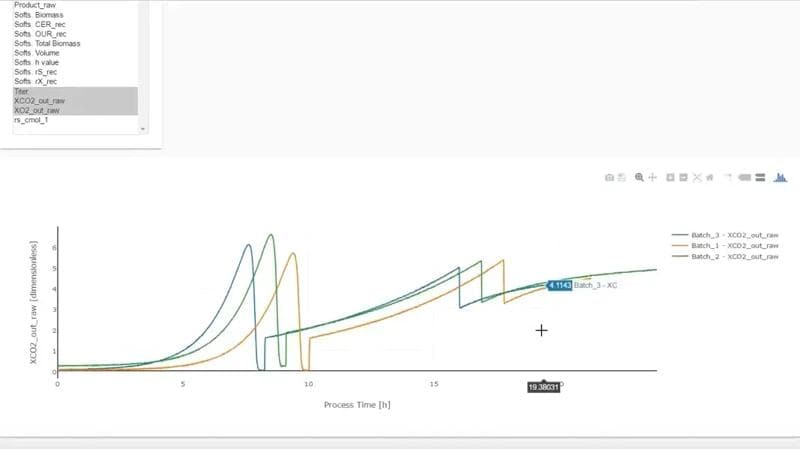
You can measure the biomass concentration with a soft sensor based on off-gas measurement. The significant advantage is that this is non-invasive and does not require an additional port to your bioreactor. To predict the biomass concentrations from the CO2 and O2 measurements of your off-gas analyzer, you need a microbial soft sensor. The microbial soft sensor uses data from off-gas analysis, mass flow controllers, and feed rates to calculate the biomass concentration. Based on parameters such as biomass composition, taken from a host stoichiometry library, the soft-sensor calculates the biomass concentrations, specific rates, and yield coefficients as outputs. The applied algorithm for the estimation is based on an equation system using multiple balances; for details, please see Wechselberger et al.
The soft sensor provides a biomass signal in real-time and turnover rates
The output of a microbial soft sensor is the biomass concentration, which is predicted in real-time in an interval of 2 minutes. Next to the biomass dry cell weight, the microbial soft sensor provides volumetric turnover rates (oxygen uptake rates, carbon dioxide evolution rates, substrate uptake rates, biomass formation rates) and corresponding specific rates (specific growth rate, specific substrate uptake rate, etc.). You can use the turnover rates to monitor the progress of your process in real-time and initiate process events. Of course, like normal hardware sensor measurements, you can use all signals for control loops, for example, to control the specific growth rate or a golden batch trajectory.
To run soft sensors on historical data for analytics, you require a state of the art bioprocess analytics software such as Werum PAS-X Savvy.
Soft sensor for many organisms
Microbial soft sensors from Werum PAS-X Savvy are applicable for processes in most common production hosts such as E. coli or P. Pastoris and will be continuously extended.
Soft sensor mode of operation
You can use the microbial soft sensor in a range between 8 and 80 g/l biomass dry cell weight, equal to 32 to 320 g/l biomass wet cell weight. This covers the full biomass range of microbial fed-batch processes. The error you can expect here is about 5 to 10% without prior calibration. You can reduce the error by performing a calibration to your specific process.
Soft sensor calibration
There is no obligation to calibrate the software sensor. However, you can improve the accuracy by performing a calibration to OD or dry cell weight measurements.
Soft sensor benefits
Perhaps more important than understanding how the soft sensors algorithms work is why soft sensors are essential to your laboratory or manufacturing facility. Traditional hard-type sensors are great when it comes to generating high-quality data. Today, state-of-the-art bioreactor instrumentation is pH, dissolved oxygen, temperature, quantification of feeds, and off-gas analysis. This progress in robust sensor technology in the last years was the basis for the global success of soft sensors.
Soft sensor summary
To put it simply, soft sensors make the most out of your data and signals that you have already collected in your bioprocess. Instead of buying more and more hardware, you should decide to use as much as possible soft sensors connected to your existing sensors, your bioreactor. Using soft sensors, you benefit by:
- Perform real-time analyzing, monitoring, and control
- Reliant calculation of parameters where no hardware sensor is available
- Reduce purchase and maintenance costs
- Reduce the risk of contamination of the bioreactor
Take action at the moment by using Werum PAS-X Savvy to analyze, monitor, and control your bioprocess process with the next generation of intelligent soft sensors.