- Insights, stories & events
- Warehouse automation
Warehouse automation in India drives the evolution of intelligent warehousing
6 min read
Intelligent warehousing is powering India’s next phase of faster, scalable manufacturing.
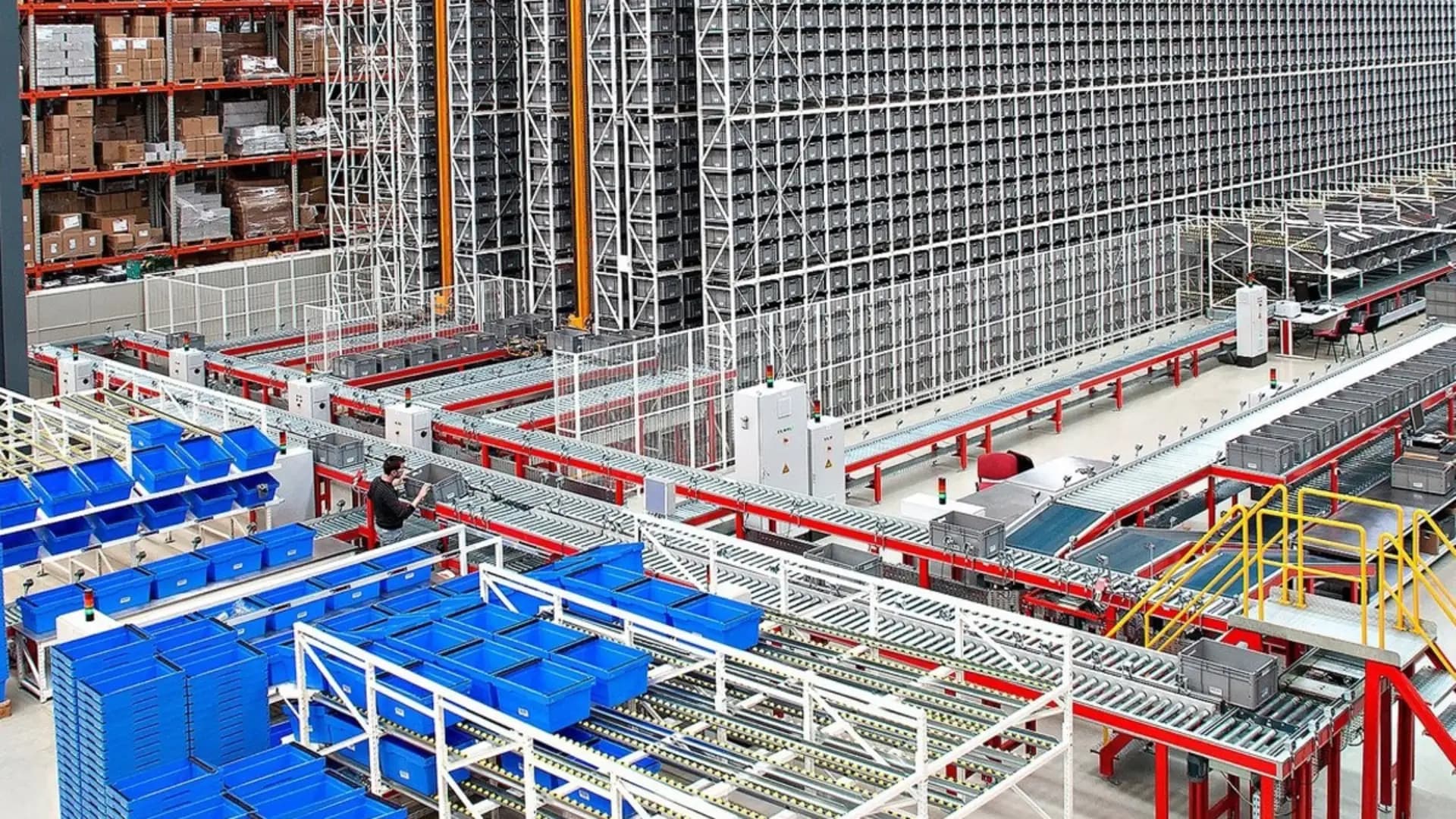
India is entering a defining phase in its manufacturing journey. As global companies diversify their supply chains and Indian manufacturers expand capacity, the country is increasingly positioning itself as a global manufacturing hub.
The Economic Survey 2025–26 estimates that India accounted for 2.9% of global manufacturing gross value added (GVA) in 2024, highlighting both the progress already made and the significant opportunity ahead. This transformation is visible across sectors, with electronics production expanding significantly over the past decade and investments in semiconductors, automotive, batteries, pharmaceuticals and other high-value manufacturing creating increasingly sophisticated production ecosystems.
But there is an important question behind this growth:
Can India's warehouses keep pace with the manufacturing ambitions of the country?
Evidently, the answer lies in warehouse automation in India but not automation viewed simply as replacing forklifts with machines. The next phase requires intelligent, integrated and application-specific automation that connects storage, material movement, production and data into one ecosystem.

“India does not need automation for automation’s sake. It needs the right combination of technologies, engineered around the business outcome each warehouse must achieve.”
Suunil Dabral
Senior VP APAC
Manufacturing growth is creating a new warehouse challenge
As Indian manufacturing scales, warehouses are facing a different set of pressures.
More production means more raw materials, work-in-progress inventory and finished goods. More stock-keeping units (SKUs) create greater inventory complexity. Higher customer expectations demand faster material availability, production feeding and dispatch.
At the same time, land and labour costs are encouraging manufacturers to draw significantly more value from every square-meter of their facilities.
These pressures are particularly relevant for industries such as automotive, electronics, semiconductors, battery manufacturing, fast-moving consumer goods (FMCG), pharmaceuticals and food.
The warehouse can no longer operate as a passive storage location. It increasingly needs to become an intelligent extension of the manufacturing operation.
India's logistics ecosystem is also becoming more digitally integrated. Government initiatives such as PM GatiShakti and the National Logistics Policy are focused on creating a more connected, data-driven and efficient logistics ecosystem.
For manufacturers, this creates an opportunity to rethink intralogistics at the same time as they expand manufacturing capacity.
Warehouse automation in India needs to move beyond individual machines
One of the biggest changes taking place in warehouse automation is the shift from purchasing individual pieces of equipment to designing complete solutions.
A stacker crane can provide high-density automated storage and retrieval. A pallet shuttle can dramatically improve storage density and throughput in the right application. Autonomous mobile robots (AMRs) and automated guided vehicles (AGVs) can automate material movement. Conveyors can create predictable and repeatable material flows.
Software can coordinate these technologies and provide greater visibility across the operation. But the real value comes when these technologies work together.
From equipment selection to system design: The Körber Advantage!
Körber's approach is built around this principle: warehouse automation should be engineered around the customer's process, throughput, storage requirements and future growth rather than forcing every operation into a standard technology.
Its portfolio spans automated storage, shuttle-based pallet storage, stacker cranes, AMRs, AGVs, conveyors, pallet handling and software.This creates an important distinction between automation equipment and an automation ecosystem.
A manufacturer may invest in a highly capable automated storage and retrieval system (ASRS), for example, but the overall business outcome will depend on how that system interacts with production, material movement, inventory management and enterprise systems.
The real opportunity is therefore to design the warehouse as an interconnected system rather than a collection of standalone technologies.
The right technology depends on the business problem
There is no single technology that can optimize every warehouse.
The right solution depends on factors such as storage density, throughput, SKU profile, product characteristics, building height, available footprint, material flow and future expansion plans.
Pallet shuttle systems for high-density storage
For operations requiring very high storage density, a multi-deep pallet shuttle system can be highly effective.
Shuttle-based pallet storage is designed for multi-deep storage across multiple levels, with satellite vehicles, shuttle cars and vertical movement working together to maximize storage within a limited footprint.
For manufacturers operating in land-constrained environments, this can be particularly valuable because greater storage density can potentially be achieved without proportionally increasing the warehouse footprint.
Stacker cranes for high-bay automated storage
For high-bay warehouses requiring automated storage and retrieval, stacker cranes can provide precise pallet handling while making better use of vertical space.
These systems can be configured around factors such as load characteristics, building height and cycle-time requirements.
The ability to utilize vertical space effectively can become increasingly important as manufacturers look to expand capacity while controlling real-estate requirements.
Software is becoming the connective layer
As physical automation becomes more sophisticated, software increasingly becomes the layer that connects the different elements of the operation.
Körber's K.OneX software, for example, is designed to act as a control layer for warehouse automation, helping coordinate automated processes and connect operational data across the system.
This connectivity is important because a modern warehouse does not operate in isolation.
Warehouse management systems (WMS), warehouse control systems (WCS), enterprise resource planning (ERP) platforms and production systems all need to work together to provide the right information at the right time.
The question therefore should not simply be:
“Which automation technology should we buy?”
It should be:
“What is the most optimized combination of technologies for our business today — and five to ten years from now?”
That shift in thinking can fundamentally change how manufacturers approach automation investments.
India needs global innovation with local expertise
For Indian manufacturers competing in global markets, warehouse automation also must deliver more than technology.
It must deliver reliability, local engineering capability, application expertise, service responsiveness, scalability and integration with existing infrastructure and enterprise systems.
This is where global technology experience combined with local market understanding becomes important.
Körber brings global expertise in supply chain automation while its India operations provide local engineering, implementation and service capabilities. The company supports customers across the automation journey from system design and technology selection through implementation and ongoing support.
This combination matters because every Indian manufacturing environment has its own realities.
Building constraints, product characteristics, temperature conditions, throughput requirements, labour models, SAP or other ERP environments, safety requirements and future expansion plans can all influence the right automation architecture.
The most effective automation strategy therefore starts with understanding the operation and not selling a machine.
From warehouse automation to intelligent intralogistics
The next evolution will be more connected. As manufacturers digitize their plants, warehouses will increasingly become part of the broader digital manufacturing ecosystem.
Data from storage, material movement, production and inventory can enable better planning and decision-making, with AI, advanced sensing, digitalization and software complementing physical automation.
The role of the warehouse is therefore changing from simply storing and moving goods to creating an intralogistics system that can sense, respond, optimise and scale with the business.
This shift enables manufacturers to move from reactive warehouse management towards more predictive, data-driven operations. As India’s manufacturing base becomes more sophisticated and globally integrated, warehouse performance will increasingly become a competitive differentiator for companies serving global markets.
Five questions manufacturers should ask before automating
For manufacturers evaluating automation, five questions should guide the conversation:
- What storage density can be achieved without compromising throughput?
- Which combination of stacker cranes, shuttle systems, AMRs, AGVs and conveyors best fits the material flow?
- How will automation integrate with WMS, WCS, ERP and production systems?
- Can the solution scale with increasing production volumes and SKU complexity?
- Who can provide technology, engineering, integration and lifecycle support as one ecosystem?
These questions shift the conversation from buying equipment to designing business outcomes.
Building India's manufacturing advantage from the inside out
India's manufacturing opportunity is not just about expanding production capacity but building globally competitive operations around it. As factories become smarter and more automated, warehouses must evolve with them. For Körber Business Area Supply Chain, this means going beyond automation technology. With global innovation, local expertise and an ecosystem spanning pallet shuttle systems, stacker cranes, material handling, robotics, software and digital capabilities, Körber Business Area Supply Chain helps manufacturers design optimised automation architectures around their specific requirements.
As India strengthens its position as a global manufacturing hub, the future will depend on how efficiently factories move, store and manage what they produce.
The future of Indian manufacturing will be built not only on the shop floor, but also inside the intelligent and connected warehouse.
Get to know our authors

Samruddhi Surse
Business Development Manager, Körber Supply Chain India
Samruddhi Surse is a Business Development Manager with a Mechanical Engineering background, focused on strategic growth, automation and intelligent intralogistics.
You may also be interested in:

Connect with us
Let’s talk about future-ready solutions for your business.
Contact