The paths and strategies used by digitization processes in industry differ widely, yet they share a vision: a fully automated "smart factory" which is self-regulating – both as a whole and in every detail – and detects the optimum settings for each parameter to ensure maximum overall equipment effectiveness (OEE).
Companies are already taking steps towards achieving this goal through numerous individual projects. When approaching tasks of this nature, it is important to define clear goals for increasing the OEE of a machine, line or entire production system. Otherwise, companies run the risk of losing track of their overall aims. "Whether it’s reducing waste or optimizing quality – the journey is as individual as our customers," says Marco Castro, Head of Hauni Consulting.
Many goals, one path
As Castro explains, the specific tasks and measures involved in the optimization can differ significantly at the project level. "However, it makes sense for the project design to follow a set pattern. It starts with the definition of the goal. Then we proceed to identification, collection and analysis of the correct data, derivation of actual improvements from that data, checking the success of individual measures and ensuring that the optimization retains its effectiveness over the long term."
The right choice
In recent years, Hauni has equipped its machines with the sensors, network connections and visualization systems necessary for efficient monitoring. As so often, however, the devil is in the detail – or, more precisely, in the choice of details. "Our state-of-the-art M-Generation machines have a total of around 3,000 different parameters. On average, 10 percent of these – i.e. around 300 – are relevant for achieving a specific goal. An operator will usually be familiar with about 25 of them and an expert with a further 25 – that leaves another 250 parameters. Identifying these requires extremely specialized knowledge."
This is why Hauni not only supports customers in OEE projects by supplying the right tools, such as operator assistance systems, trend and alarm features or manufacturing operation management. Customers who work with Hauni Consulting on their OEE projects also save time and resources, and benefit from the resolution of complex issues, such as selecting the right optimization parameters. Hauni’s consultants analyze the situation on-site with the customer and, if necessary, not only draw up a roadmap for the specific project but also recommend the most efficient way to sequence the various potential improvement projects. “Customers can successfully implement an OEE project on their own using Hauni solutions. After all, we have built of lot of our know-how into the tools themselves,” says Castro. “However, by using our consulting services, customers can also ensure that they extract the maximum performance from these tools at all times and proἀt from our experience in managing many similar projects all over the world.”
Measurable success for the customer
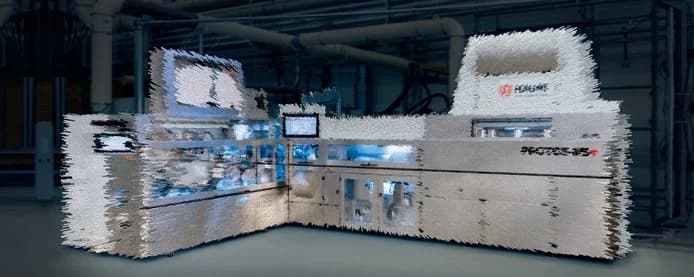
The example of a successful LES quality improvement project for a customer who wanted to boost the performance of his PROTOS/Focke lines by reducing loose end waste offers some useful insights into the specifics of this process. “After recording and extracting all the machine data, we ran a performance comparison to identify the best machine and set it as a reference,” reports Castro. “Effective monitoring is the cornerstone of performance controlling. It allows us to make meaningful comparisons of the overall performance and the target and actual values for individual parameters as well as measure the success of each change we implement. We filtered out differences by comparing the data for various parameters, determined the inḀuence of different parameters on the target values and modiἀed the data sets accordingly.” The final OEE comparison proved the project was a success. LES line waste fell by 36 percent while the mean shift output rose by 11 percent – a positive side effect.