- Insights, stories & events
- Full-line automation
Full-line automation for pharmaceutical and biotech manufacturing: Why orchestration defines performance
6 min read
Discover how full-line automation helps pharma and biotech manufacturers improve performance, compliance and scalability through end-to-end orchestration.
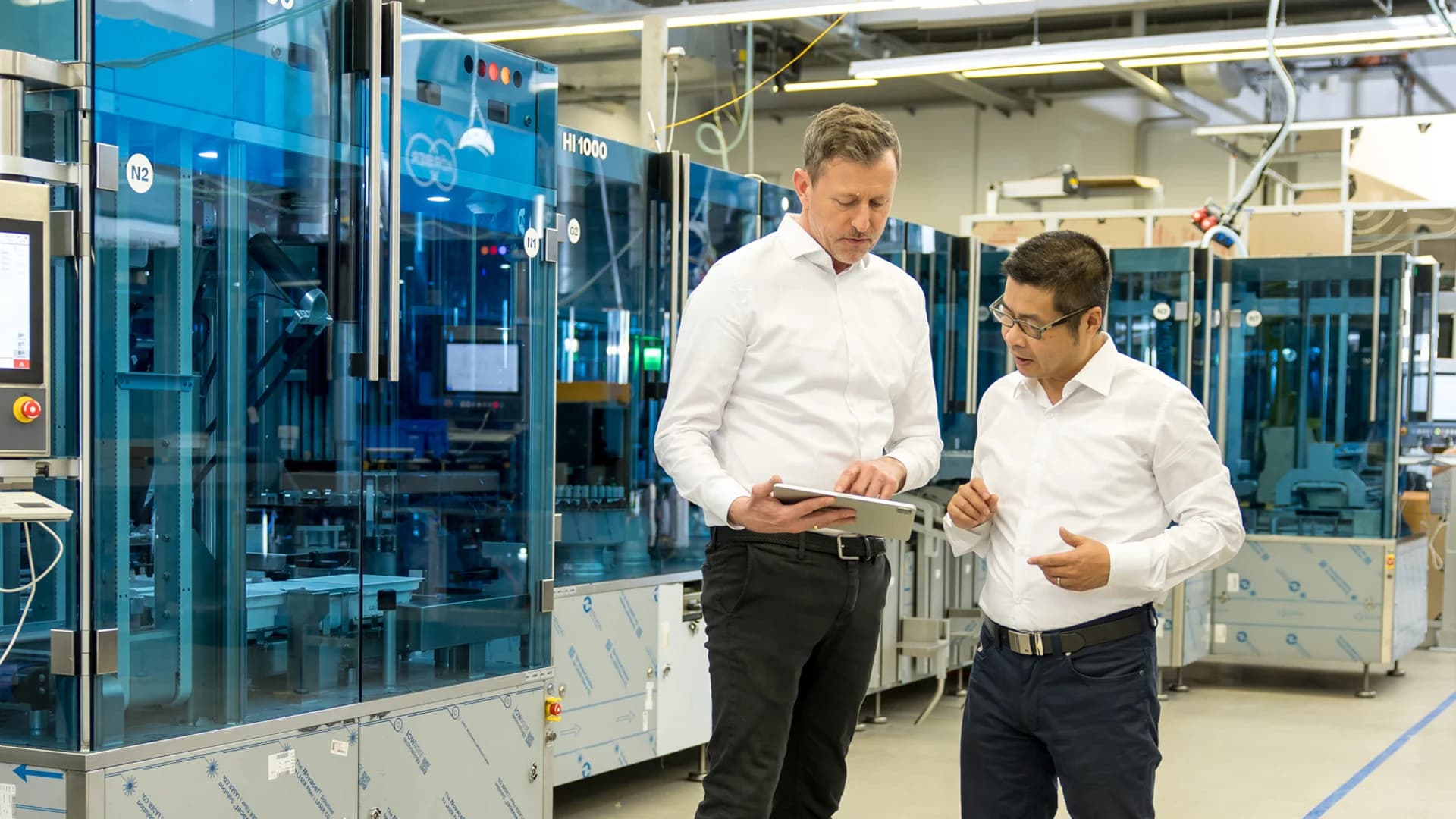
Automation is no longer a differentiator in pharmaceutical and biotech manufacturing—it is a given.
What sets leading manufacturers apart today is how effectively they orchestrate full-line automation across complex production environments. Machines, material flow, software, and data must operate as one system to deliver consistent performance, accelerate release cycles, and ensure audit-ready quality.
This shift—from isolated automation to integrated, full-line manufacturing systems—is redefining how modern pharmaceutical and biotech production is designed, scaled, and optimized.
Highlights
- See how full-line automation transforms pharmaceutical and biotech manufacturing into a connected, high-performance production environment
- Learn why integrating inspection, packaging, material, handling systems, and digital systems is critical for scalability, compliance, and operational efficiency
- Discover how manufacturers are turning complex production environments into controlled, data-driven operations through end-to-end orchestration
From automation to full-line integration in pharma and biotech
Pharmaceutical and biotech manufacturers across the life sciences industry are facing increasing complexity. Expanding product portfolios, smaller and more personalized batches, global regulatory requirements, and rising pressure on time-to-market are reshaping production.
In biotech and advanced therapy environments in particular, process sensitivity and variability add further complexity to manufacturing operations.
In many facilities, automation has evolved step by step. While this has created highly capable systems, it has also introduced fragmentation—manual handoffs, disconnected data, and delays in batch release.
Full-line automation addresses these challenges by connecting all elements of production into a unified system. When equipment, processes, and data flows are aligned, manufacturers can enable review by exception, move toward real-time release (RTR), and ensure end-to-end traceability.
Performance is no longer defined by individual machines—but by how effectively the entire production line works together.
What full-line automation means in pharmaceutical and biotech manufacturing
Full-line automation refers to the end-to-end integration of all production elements, including process technologies, inspection, packaging, material, handling systems, and digital solutions.
Rather than operating as separate layers, these elements are designed as one connected manufacturing system.
- Inspection and inline analytics embed quality directly into the process, which is particularly important in biotech manufacturing environments where process deviations can directly impact product quality.
- Packaging and end-of-line automation stabilize output and ensure reliable preparation for distribution, including sensitive or high-value products.
- Integrated handling systems enable continuous, controlled transport across all process steps, reducing manual intervention and protecting product integrity.
Underlying all of this is a connected digital backbone that links machines, processes, and quality systems into a unified data model. This enables real-time visibility, structured documentation, and data-driven decision-making across the entire production line.
Only when these elements are orchestrated together does automation translate into measurable and scalable performance.
Smart factory strategies for pharma and biotech manufacturing
The impact of a smart factory approach becomes most visible in real production environments.
- In integrated production lines, processes are synchronized across all modules.
- Material flows continuously without manual intervention, reducing errors and increasing efficiency.
- Inspection systems ensure consistent quality decisions.
- Automated handling supports the safe transport of sensitive containers such as vials, syringes, and biologics formats.
- At the same time, digital systems such as MES provide real-time visibility into production and quality data. This enables faster decision-making and ensures that production, quality, and documentation remain aligned—even in highly regulated and variable environments.
Such integrated setups demonstrate how full-line automation improves throughput, reduces complexity, and strengthens compliance across pharmaceutical and biotech manufacturing.
Making integration tangible: a connected production reality
The benefits of full-line integration become especially visible when all elements of the production line operate as one integrated system.
- In one combined line concept, synchronized material flow enables seamless transitions between process steps while minimizing manual intervention.
- High-speed inspection technologies support reliable quality decisions without slowing throughput.
- Automated handling solutions ensure gentle and controlled transport of sensitive products throughout the line.
- At the same time, connected digital systems provide continuous visibility into production and quality data. This creates transparency across the value chain and helps ensure that production, quality, and documentation remain aligned even as production requirements change.
Such examples demonstrate that full-line integration is not a theoretical concept, but a practical approach already delivering measurable results in pharmaceutical and biotech manufacturing.
Experience full-line automation in operation
See how a fully integrated production line connects inspection, handling, and packaging into one coordinated system. Seamless machine to machine transitions, automated material flow, and synchronized processes reduce manual intervention and create stable, predictable performance across the line.
We value your privacy.
We require your consent. This video is hosted by YouTube, a service of Google LLC (USA). When you watch the video, YouTube receives your IP address, can store cookies on your device, and link this activity to your user account. For this, you must accept YouTube cookies in the Cookie Settings. You can also select 'Accept all Cookies' and thereby consent to further cookies that allow us to make the website more user-friendly, analyze user behavior, and show you personalized advertising on other websites. You can revoke your consent at any time via the cookie settings link in our footer. Further information can be found in our Privacy Policy.
Experience integrated supply chain automation in operation
Discover how production machines are connected through integrated supply chain solutions—linking shopfloor automation with logistics and control layers. By orchestrating machines, material flow, and systems such as MES, WMS, or WCS, manual effort is reduced while transparency, coordination, and operational control increase.
We value your privacy.
We require your consent. This video is hosted by YouTube, a service of Google LLC (USA). When you watch the video, YouTube receives your IP address, can store cookies on your device, and link this activity to your user account. For this, you must accept YouTube cookies in the Cookie Settings. You can also select 'Accept all Cookies' and thereby consent to further cookies that allow us to make the website more user-friendly, analyze user behavior, and show you personalized advertising on other websites. You can revoke your consent at any time via the cookie settings link in our footer. Further information can be found in our Privacy Policy.
Adapting full-line automation to diverse production environments
Production environments across pharmaceutical and biotech manufacturing vary significantly—from high-mix, low-volume production to large-scale manufacturing.
In high-mix environments, which are common in biotech and personalized medicine, flexibility is critical. Frequent product changes require structured processes, guided workflows, and modular systems to ensure consistent execution. In high-volume pharmaceutical production, stable throughput and continuous flow across inspection, handling, and packaging are essential to avoid bottlenecks.
Many manufacturers operate hybrid production models where volumes fluctuate, and product portfolios evolve. In these environments, modular full-line systems and standardized interfaces allow production to scale without reengineering while maintaining consistent execution and data integrity.
Across all scenarios, the key success factor remains the same: integration across the entire production line.
Data-driven manufacturing and real-time release (RTR)
As regulatory expectations continue to evolve, data-driven manufacturing is becoming a central capability across pharmaceutical and biotech production.
Technologies such as Process Analytical Technology (PAT) and continuous manufacturing enable quality to be built directly into the process. Their full value, however, depends on a connected system where data is automatically captured, contextualized, and made available in real time.
In integrated environments, data becomes actionable evidence. This supports review by exception, enables real-time release, and ensures audit-ready documentation across all production steps.
Quality is no longer a separate phase at the end of production—it becomes an inherent part of the manufacturing process itself.
Industry analyses continue to show that smart factory strategies, digital integration, and connected manufacturing environments are becoming key priorities for pharmaceutical manufacturers preparing for scalable, data-driven operations.
The Körber approach to full-line automation
Full-line automation is often approached as a complex integration effort. At Körber, it is designed as a system capability from the outset.
Körber combines inspection technologies, packaging systems, material, handling systems, software, and lifecycle services into an integrated ecosystem tailored to pharmaceutical, biotech, and life sciences manufacturing environments. By designing these elements to work together from the beginning, interfaces are reduced, validation is simplified, and implementation risks are minimized.
This approach ensures that performance is achieved across the entire production line—not in isolated parts. It creates a scalable foundation that supports both traditional pharmaceutical production and the increasing complexity of biotech and advanced therapies.
Conclusion: The path to controlled, scalable manufacturing
The future of pharmaceutical and biotech manufacturing is not defined by more automation, but by better orchestration.
Full-line integration transforms complex production environments into controlled, scalable systems. It connects machines, processes, and data across the entire value chain, improving efficiency, compliance, and operational performance.
For pharmaceutical and biotech manufacturers, this is the most direct path toward a factory of excellence—and the foundation for future data-driven and AI-enabled manufacturing operations.
Explore how end-to-end automation turns complexity into controlled performance
As pharmaceutical and biotech operations become more diverse, performance depends on how effectively machines, software, data, and services are orchestrated as one system. An integrated, full-line approach reduces interfaces, strengthens operational control, and enables scalable performance across the entire production line.

Connect with us
Let’s talk about future-ready solutions for your business.
Contact