- Insights, stories & events
- Supply Chain Insights
- SAP WM migration
Migrating from SAP WM – how Körber’s business case analysis sets you up for a smooth transition
7 min read
(…and what a missing storage bin has to do with it)

It was a typical Monday morning: the warehouse was up and running, pallets were moving, scanners were beeping – and the inventory team was ready to check one of the last open items. The task sounded trivial: a small residual stock was supposed to be in storage bin A-17-03, which SAP WM still listed as a normal but blocked bin. The inventory clerk looked at her handheld – A-15, A-16… and then… at the break room. Where bin A-17-03 should have been, there was a fridge, a coffee machine on top, a sink, a small table, and two chairs.
It turned out the storage bin had been converted into a break room five years earlier. Unfortunately, the WM system never got the memo and had kept the bin active all along. The shift supervisor smirked: “Well, if I’d known, I would’ve reopened the bin and managed our coffee inventory in there.”
The anecdote got a good laugh—but also a reality check. It highlights what many companies experience: systems that have evolved over years often continue to carry data and processes that no longer exist in the real world.
And that’s precisely where the need for migration begins.
SAP WM over time – proven, but technologically outpaced
For more than 30 years, SAP LE-WM has been one of the world’s most widely used warehouse management systems. Processes for inventory management, bin management, and order processing have been implemented across virtually every industry – from purely manual setups to complex distribution centers.
Because standard functionality was limited in areas such as putaway/picking strategies and process visualization, customizations were almost always necessary right from the start. There was no built-in material flow component. Automated warehouses therefore required integration with external warehouse control systems. Some providers – including Körber – offered SAP-integrated material flow applications as SAP add-ons.
Over the years, SAP WM installations have been enhanced individually. The result is a landscape of highly customized WM systems whose complexity is often understood by only a handful of experts. That very complexity makes migration demanding – and structured preparation indispensable.
Clear facts: why the pressure is mounting
Even if many companies still have SAP WM firmly under control, the official timeline is unambiguous:
- Permission to use SAP WM in compatibility mode under SAP S/4HANA ends on May 31, 2026.
- Mainstream maintenance for SAP WM on ECC ends on December 31, 2027.
- December 31, 2030 is final: after that, SAP WM may no longer be used productively.
These milestones aren’t just technical – they define very real action windows for companies still running WM.
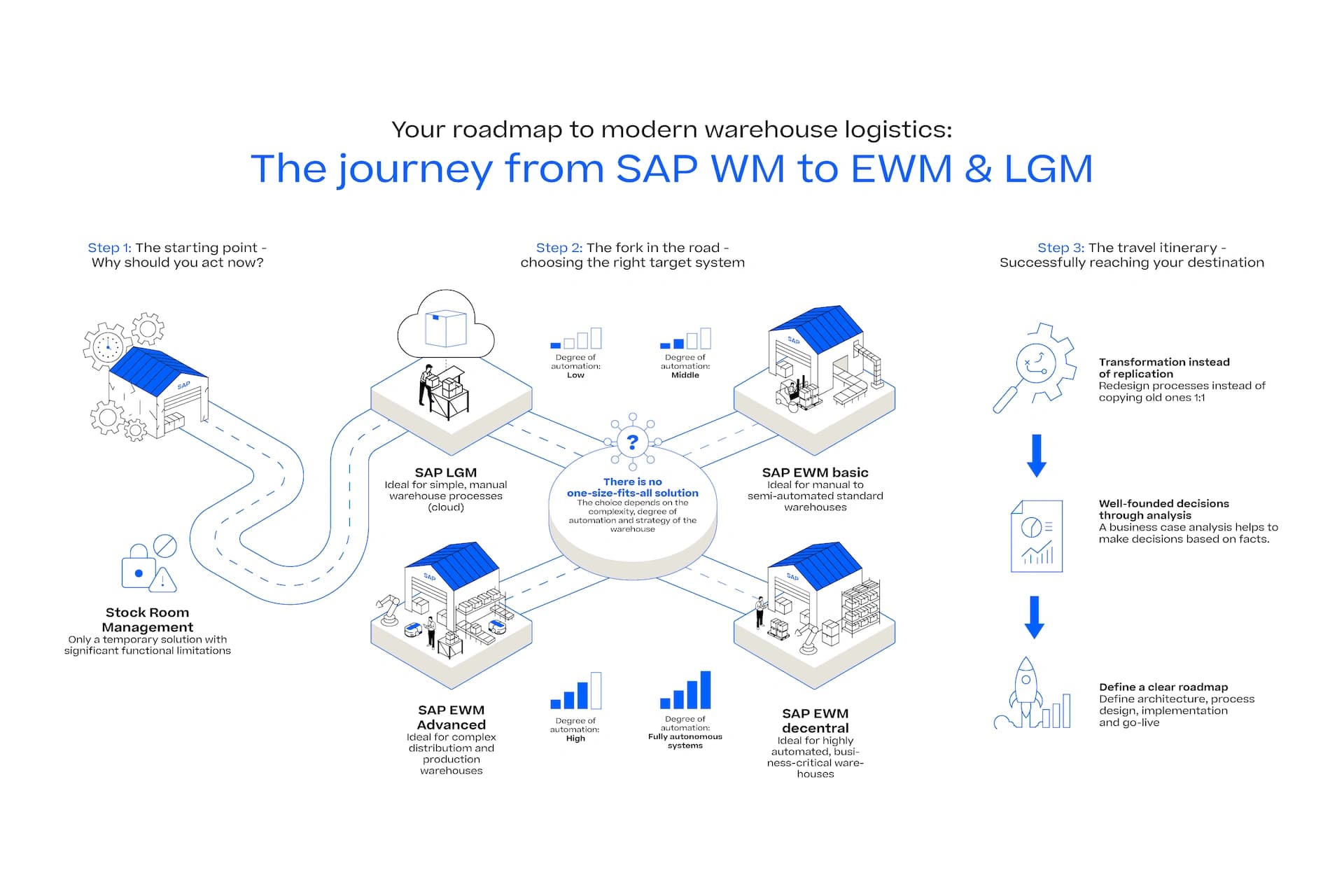
Choosing the right target architecture – there’s no one-size-fits-all
SAP offers several target architectures that make sense depending on complexity and strategy:
- Stock Room Management (transition option only)
- SAP LGM
- SAP EWM Embedded (Basic)
- SAP EWM Embedded (Advanced)
- SAP EWM Decentralized
There is no report that automatically analyzes your current solution and recommends the best target system. The choice depends on factors such as process complexity, degree of automation, scalability needs, and the strategic importance of the site. This is exactly where a structured analysis pays off.
Evaluation of migration options
Solution | System Architecture | Use Case | Scope | Recommendation |
|---|---|---|---|---|
Stock Room Management | Integrated into S/4HANA | Simple warehouse processes | Basic functions (similar to SAP WM), no further development | Suitable only as a transitional solution |
SAP LGM | Stand-alone cloud instance (Public Cloud) | Simple warehouse and transport processes | Combined warehouse and transport management | Sensible alternative for satellite warehouses and business areas with low warehouse/transport demands; future-oriented; supports cloud strategies |
EWM Embedded (Basic) | Integrated into S/4HANA | Manual to semi-automated warehouses | Core functions of warehouse management | Often sufficient for simple and mid-complex warehouses |
EWM Embedded (Advanced) | Integrated into S/4HANA | Complex, automated warehouses | Full scope incl. automation, slotting, labor management | For demanding, highly automated warehouses |
EWM Decentralized | Stand-alone EWM instance on S/4HANA, decoupled from ERP | Business-critical warehouse logistics | Full scope, maximum flexibility & performance | For highly complex, high-performance warehouses; risk mitigation through ERP decoupling |
You may also be interested in: