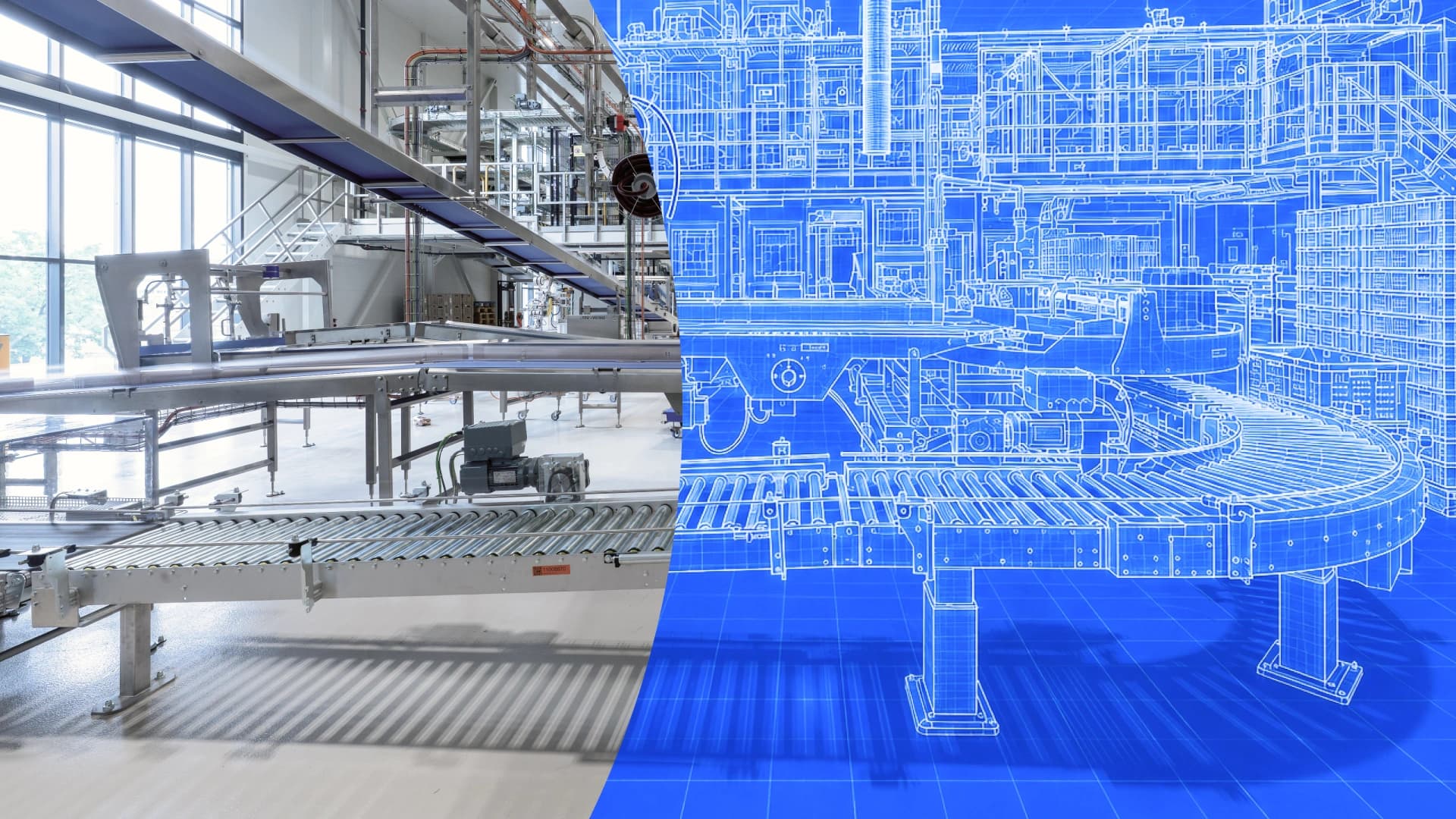
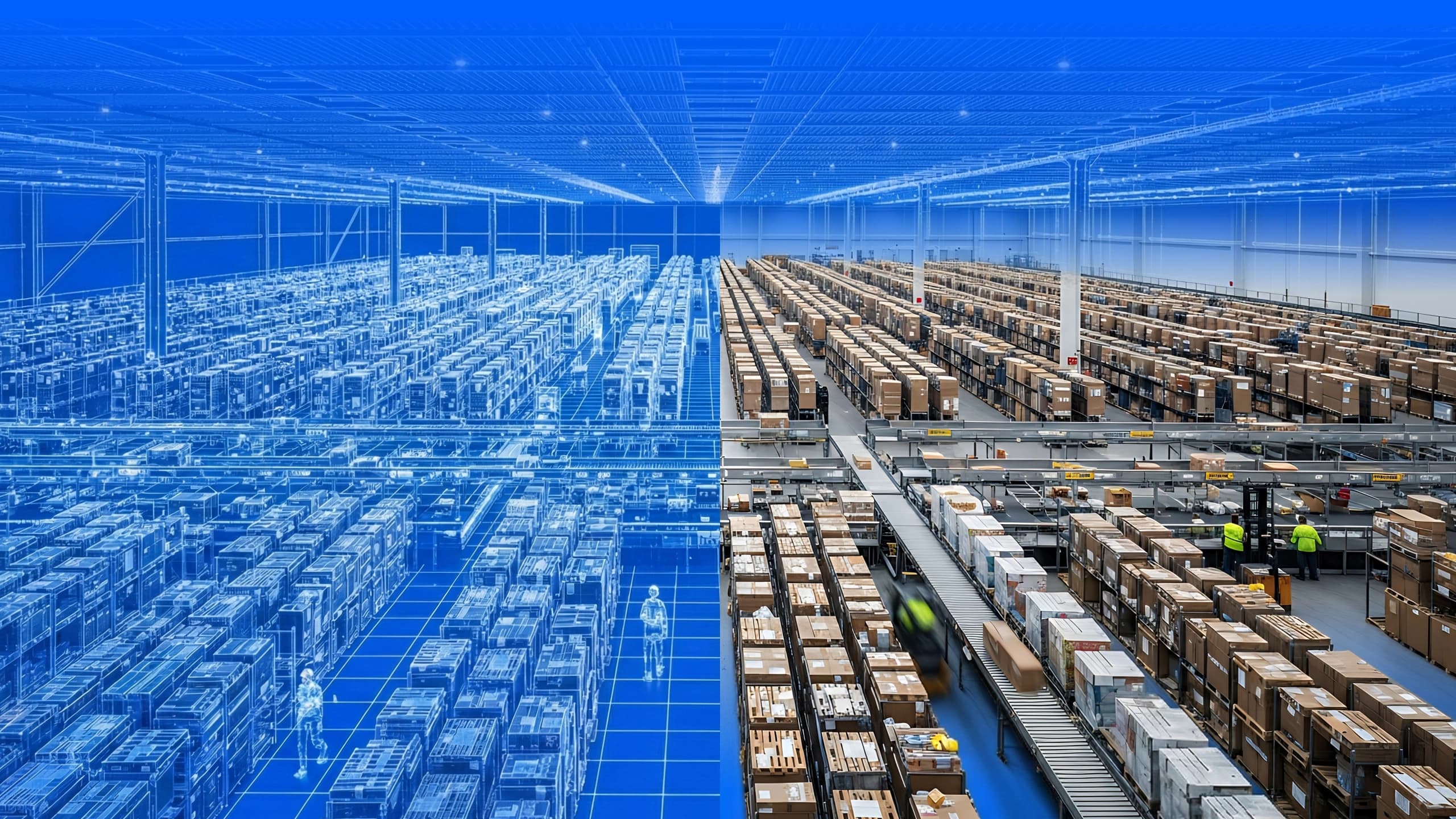
The digital twin has a terminology problem. Everyone in intralogistics means something different by it and it's often reduced to a 3D visualization or a handful of KPIs. But its real value lies elsewhere: a digital twin is only as robust as its ability to do more than represent. It should allow planning teams to test assumptions, examine system behavior, and connect future scenarios to today's operational reality – before a single investment is made.
That's why a meaningful digital twin rests on three pillars: layouts, simulation, and emulation. Each serves its own purpose and each has its limits. Only in combination do they create a decision-making foundation that doesn't just appear plausible, but holds up against operational reality.
Three perspectives on the same system
A 3D layout maps the spatial structure of a system: floor space, heights, pathways, interference contours, and material flows. It creates orientation and forms the basis of every planning process.
Simulation examines dynamic behavior: How does the system respond to changing order structures? Where do bottlenecks or wait times emerge? Which resources come under pressure? It reveals whether assumptions hold under realistic load profiles.
Emulation tests operational logic. It examines how controls, software, hardware, and material flows actually respond in real time: Do priorities, strategies, and system decisions work the way they were designed to? Virtual commissioning becomes possible, and on-site project timelines can be reduced.
Together, they create a complete picture: the layout describes the structure, simulation the dynamics, and emulation the system behavior.
Why no single pillar is enough
Layouts translate requirements into spatial structure. But they primarily show how a system is intended to work, not necessarily how it will behave in operation. Bottlenecks and backlogs only become visible when dynamics are examined across different scenarios.
Simulation makes exactly those effects visible: peak loads, resource conflicts, critical interfaces. At the same time, its value depends heavily on the quality of the underlying assumptions.
Emulation brings real control logic into play. It shows whether strategies and system responses actually function as intended, but doesn't automatically answer whether the layout and overall design are robust and resilient enough under real load profiles.
None of these disciplines replaces the others.
Common planning misconceptions
Many planning errors stem from assumptions that seem perfectly reasonable:
- A logically designed layout will automatically operate efficiently.
- Average performance figures are sufficient as a planning baseline.
- Control logic can be optimized later.
- More automation compensates for weaknesses in system design.
In practice, systems rarely fail at average load. They fail at peaks, bottlenecks, or untested control strategies. This is exactly where an integrated digital twin approach proves its worth: assumptions aren't just discussed, they're verified.
Simulation and emulation as decision-making tools
Simulation is not a visual showpiece, it's a tool for better decisions. It helps clarify under what conditions a system functions, when it reaches its limits, and why.
Emulation complements this by testing the operational intelligence of the system: priorities, routing decisions, and responses to disruptions. Problems that would otherwise only surface during commissioning or ramp-up can be identified virtually, far earlier in the process.
Layouts as the spatial foundation
Layouts are more than a preliminary sketch. They encode material flow, spatial logic, access points, and expandability. A weak layout can only be compensated for to a limited extent later, while a strong layout creates the foundation for meaningful simulation and emulation.
Strength through integration
The digital twin is not a single tool. Its strength lies in how the three pillars work together:
- Layouts create spatial clarity
- Simulation makes dynamics and risks visible
- Emulation tests operational logic
Only then does a digital twin earn its name: not a digital diagram, but a robust system model. For large-scale investments in particular, this distinction creates decisive value, because decisions don't just appear sound, they become verifiable. Beyond the planning phase, the digital twin continues to support customers throughout live operations, whether adapting shift models, preparing for peak scenarios, or navigating everyday demands.
If you are currently planning an intralogistics project and would like to take advantage of the benefits offered by a Digital Twin, please do not hesitate to get in touch with us at any time.