- Insights, stories & events
- MBR design strategic organization
Strategic organization of MBR design
2 min read
From analyzing production steps to finalizing executable instructions, a structured MBR design ensures high-quality records that drive MES success.
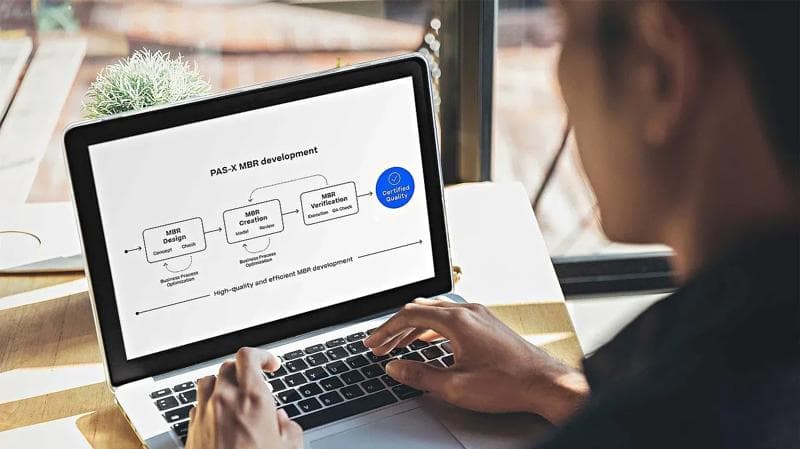
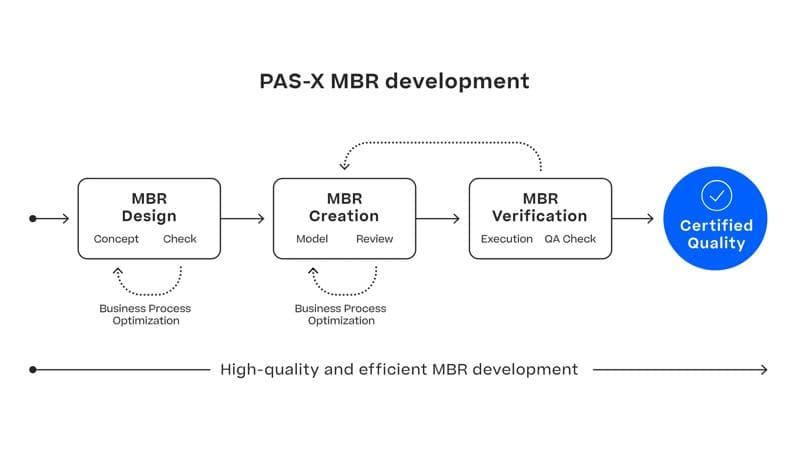
Ensuring the quality of MBR design is critical to successful MES, and, as such, the end-goal of creating high-quality MBRs must guide the entire production and review process.
Successful MBR design requires a structured approach:
Production process analysis
The production processes to be modeled in MBRs should be analyzed. This includes taking into account the requirements of stakeholders (e.g. production and QA), and the boundary conditions of other systems (e.g. ERP order structure). The result of this analysis will include the production process, structured into MBRs (e.g. bulk production, packaging), its unit operations (e.g. weighing, granulation, filling) and process steps. Such steps may include ‘assemble granulator,’ ‘granulation run,’ ‘post-run-activities,’ or ‘yield operations.’
From design outline to detailed design
The production process analysis described above leads to a design outline which can then serve as a table-of-contents for the future MBR (and batch record report). The content of the MBRs can then be translated into detailed design in manageable portions. In between each step, it’s advisable for MBR designers and future users to review progress since any changes having to be made later in the design process will require great effort. It’s advisable to keep the MBR executable, so incremental, periodic changes can be made and tested straight away.
Design styles and naming conventions should be defined early and applied throughout the design process. Predefined solutions from best-practice process libraries (such as Werum’s Content packages), and parts of already completed MBR designs or prototypes (e.g. from a fit phase) may be used to accelerate the detailed design.
Finalization
In the final stage, the focus switches from functional principles and important parts to open details. All details, including instructions, signatures and activities are added to the MBR. The scale up of the number of MBRs (e.g. duplicating) is dependent upon the similarity of the MBRs and the overall MBR design concept, but should happen before the product specific finalization.
Throughout these phases, Werum’s “Design as a Service” package provides comprehensive and best-practice solutions for the cost-effective creation of lean, high-quality and streamlined MBRs. For speedy and efficient creation, a globally oriented design team, leveraging offshore resources can be utilized.
You may also be interested in: