- Insights, stories & events
- Bioprocess efficiency & hybrid modeling
How to cut timelines and boost efficiency in bioprocess development: Unleashing the power of hybrid modeling and process intensification
6 min read
Many companies face the challenge of reducing the developmental timelines and efficiently optimize the process thereby bringing the drug to market in a faster way. In this article, we introduce a dynamic modeling approach that contributes to a new era of rapid and efficient bioprocess product development.
In a world of the ever-changing landscape of bioprocess development, the importance of faster process development while keeping product quality and process efficiency intact is the need of the hour. This not only helps the manufacturers to improve their cost of goods sold (COGS) but also makes the drugs available to patients at a faster rate which brings both parties in a win-win situation.
The increasing demand for life-saving medications to the market has led to the adoption of state-of-the-art tools and techniques. A solution to tackle this complex situation is to make use of innovative methodologies. In this article, we will demonstrate one of these methodologies, dynamic modelling, as an enabler to reduce experiments and hence fasten process development.
Make use of all data!
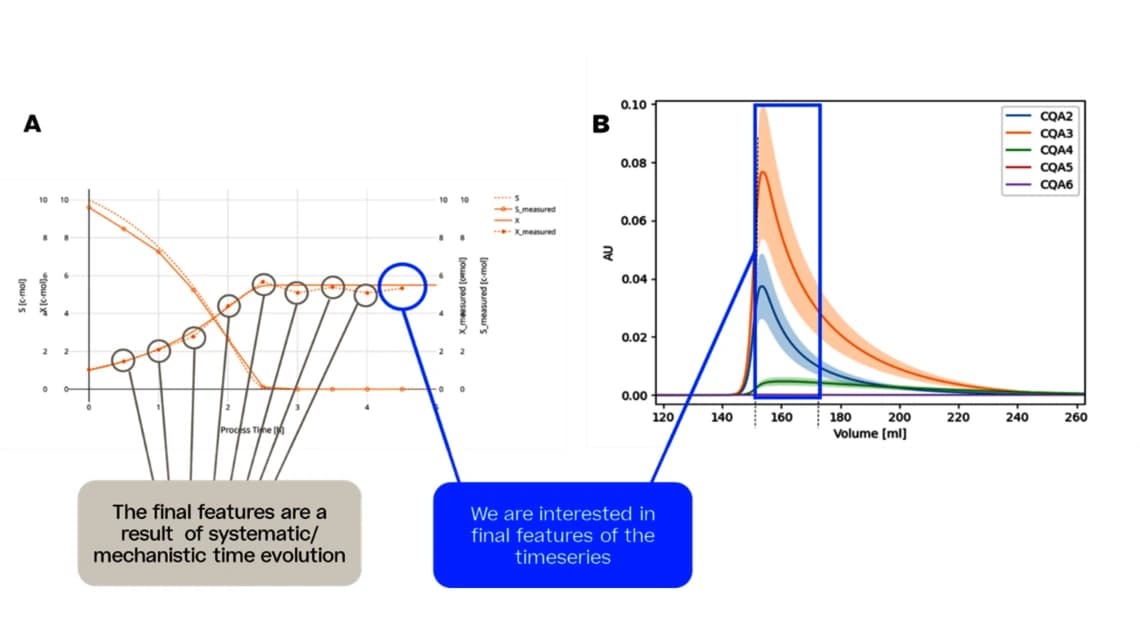
Most of the process steps that are executed have a time-dynamic behavior. See Figure 1A as an example of upstream batch fermentation or Figure 1B, a preparative chromatogram. Final features, like the end product amount of fermentation or the pool concentration of impurities of the chromatography step, are a result of time evolution. We can make use of data that has been recorded over time to identify trends and predict the final features in addition to its measurement. This prediction coupled to a filter, e.g. a Kalman-Filter, increases the accuracy of the final features and hence increases statistical power to detect critical effects or vice-versa reduces the number of experiments to detect such critical effects. Hence, we identified our first reason why dynamic modelling can reduce experiments and accelerate process development.
Dynamic and hybrid modelling as the working horse
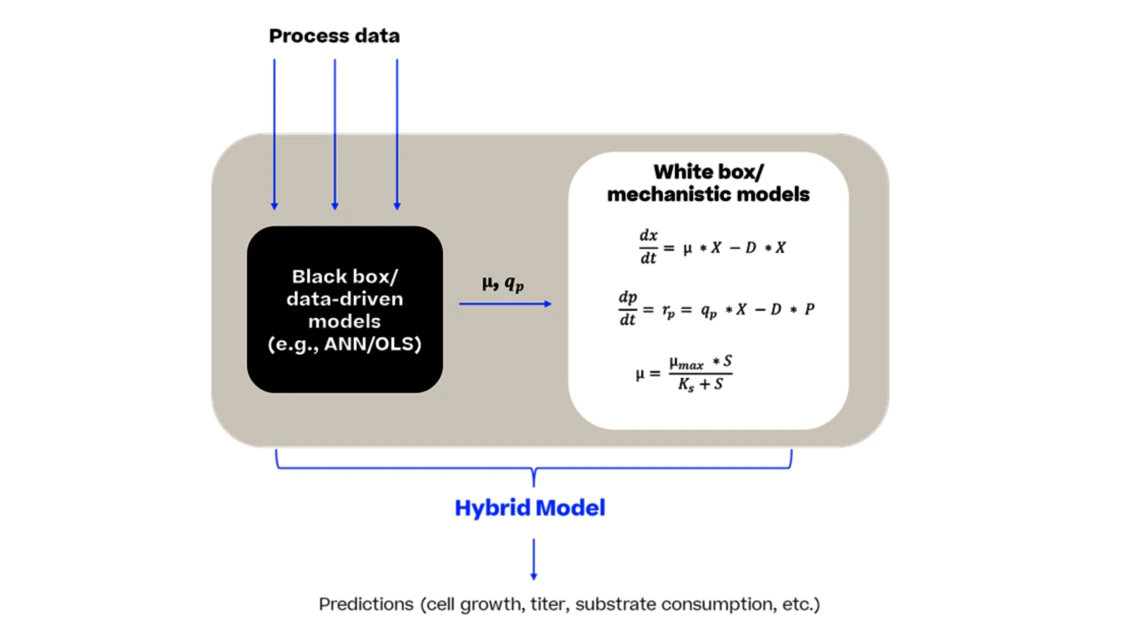
As the name suggests, hybrid modelling is a combination of mechanistic and data-driven models and is more flexible in learning mechanistic links from data. Mechanistic models, also known as “white box models”, are based on the first principles, able to explain the underlying biological and chemical phenomena involved. Usually none of the models employed in biopharmaceutical manufacturing are purely based on first principles as reaction mechanism and binding mechanisms are not known a priori from first principles. All these so called “mechanistic models” are based empirical equations, such as the Monod kinetics, to assess the reaction mechanism. Data-driven models are based on the available, experimental data generated from the process.
A typical hybrid model workflow comprises of two components:
- Estimation of specific reaction rates using empirical information i.e., data-driven approach
- These estimated values are fed into the mechanistic models for further analysis/processing as shown in Figure
Thus, hybrid models allow the combinatorial effect of mechanistic and black box models to gain better insights into the overall process thereby leading to robust and highly predictive models.
Process intensification
All our systems consist of two types of variables
- Process parameters that are controllable over time (e.g. temperature, feed, elution gradient, etc.)
- States: anything that is a result of the impact of the process parameters (VCD, viability, titer, metabolites, elution profile of impurities, etc.)
Given the initial conditions (e.g. initial VCD, metabolites etc.) and controllable process parameters over time, we can predict the states.
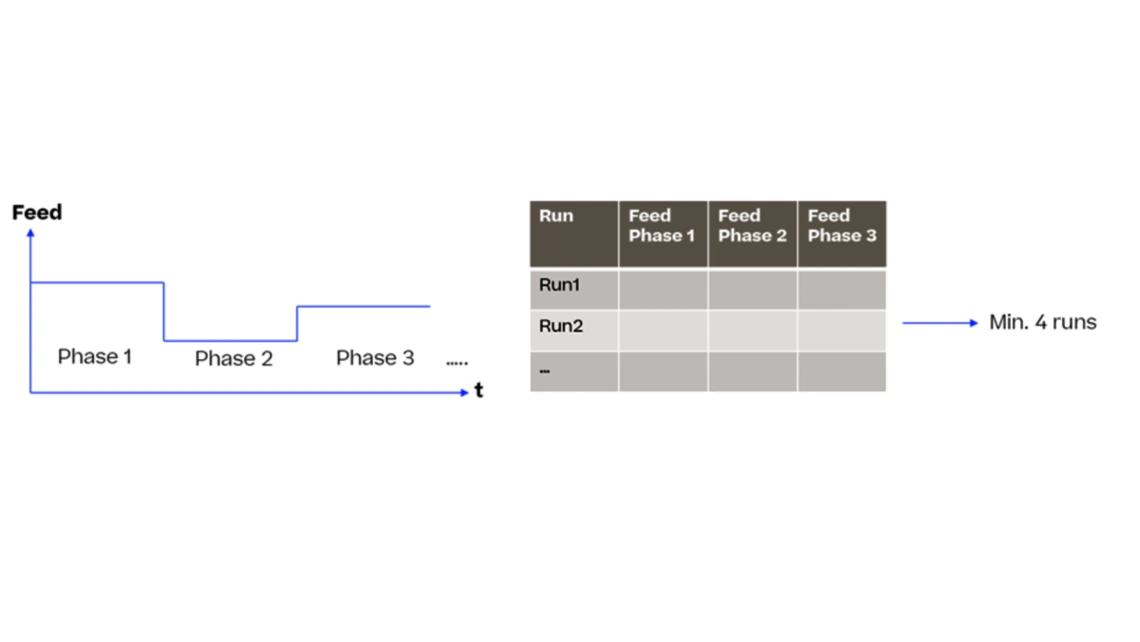
If we want to vary process parameters over time, e.g., feed profiles, we need to introduce phases in classical linear regression (e.g., Design of Experiments (DoE) design). This is also called unfolding of a time series as shown in Figure 4. In classical DoE setting we need one more run than effects in the model. Hence, if we want to incorporate the effect of all phases in the model, we need at minimum n+1 number of runs, where n is the number of phases. If we assume independence of the phases, i.e., no memory effect from one phase to another that impacts on the mechanistic relation of the next phase, we only need one run to calibrate a dynamic model.
The synergy: Amalgamation of dynamic modelling and process intensification for accelerated process development
Since we now know the individual benefits of dynamic modelling and process intensification, it’s necessary to club these methodologies and leverage the potential to achieve the larger goal of developing a process with a significant drop in developmental timelines and making the drugs available to patients as fast as possible.
To set up this architecture, below are the steps to be followed for the general workflow as outlined in Figure 4.
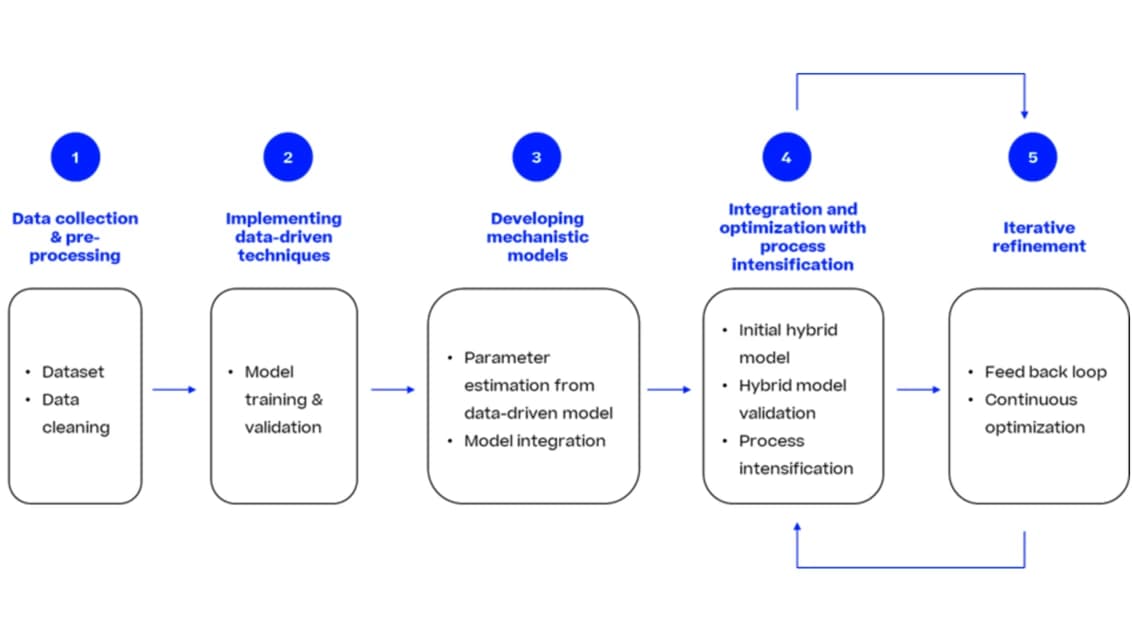
- Data collection and preprocessing:
- Overarching dataset: Collect data on process parameters and states to be modelled.
- Data cleaning: Ensure the data is accurate and relevant and check for potential outliers. - Implementing data-driven techniques:
- Model training & Validation: make use of various algorithms like OLS, ANN, etc. to build a good fit predictive model that describes the reaction rates as a function of states and process parameters. - Developing mechanistic models:
- Parameter estimation: Employ a previously trained data-driven model from the previous step to estimate the parameters like specific growth rate, product formation rate, etc. for the mechanistic model.
- Model integration & validation: Integrate these estimated parameters into the mechanistic model and validate the model for better prediction and accuracy. - Integration & optimization with process intensification:
- Initial hybrid model: Run this hybrid model using experimental data and check for model predictions and accuracy.
- Process intensification: optimize the hybrid model, specifically focusing on parameter combinations which may improve the model’s overall predictability. - Iterative refinement:
- Feedback loop: Execute an iterative procedure in which the forecasts of the hybrid model direct the subsequent experiments.
- Continuous optimization: the hybrid model is based on the results, gradually augmenting precision and effectiveness.
Conclusion: Accelerate the future of bioprocessing
Get to know our authors

Mohammad Nawaz
Senior Consultant
Mohammad Nawaz is a Senior Consultant at Körber. He holds a master's degree in Bioprocess Technology from the Institute of Chemical Technology, India. He has expertise in process development, process optimization, process characterization, and process validation along with statistical modeling and long experience in bioprocess drug substance manufacturing.

Thomas Zahel
Head of CMC Innovation Consulting
Thomas Zahel is Head of CMC Innovation Consulting at Körber. He holds a master’s degree in Biochemical Engineering from the Technical University of Graz and a PhD in applied statistics from Vienna Technical University. He has expert knowledge in theory and implementation of a multitude of statistical disciplines and long experience in developing statistical workflows for process characterization.
You may also be interested in: