Color patterns help distinguish objects
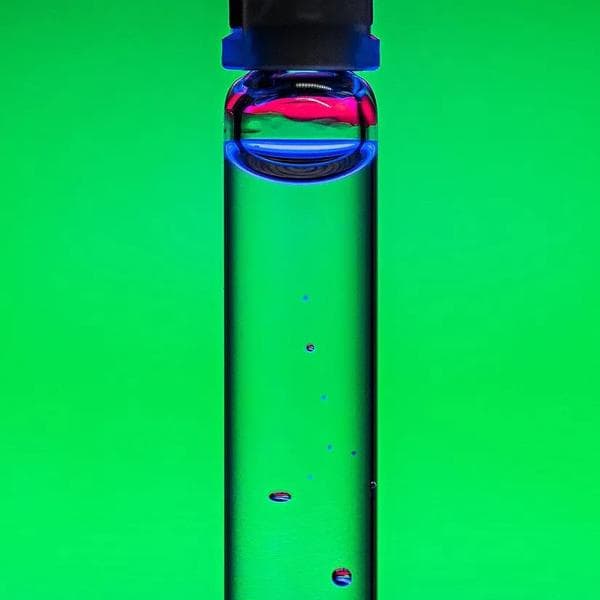
However, if the rays encounter air bubbles or particles as they travel through the liquid, one of three things will happen. A normal, opaque particle blocks the light and appears in the camera image as a dark object in front of a green background. By contrast, transparent particles such as glass particles and air bubbles refract the light and redirect it in different ways. “Because of the laws of refraction, transparent particles cause not only the rays of green light but also those of blue and red light to hit the detector, where they create a specific color pattern,” says Halbinger. “An air bubble does the same, except that air refracts light differently than glass, for example, and causes the color pattern to reverse.” This physical effect enables Bubble-X to distinguish between the two objects -and it does this within fractions of a second.
Saving millions of euros with Bubble-X
This spectral-coded illumination can cut the false reject rate during inspections by half. Whereas conventional inspection systems have an average false reject rate of two percent, Seidenader Bubble-X reduces this rate to one percent. Although this reduction may seem unspectacular at first glance, it quickly adds up. “A pharmaceutical company that produces one million units per year worth €500 each can save up to five million euros if the FRR is cut in half,” says Halbinger.
Even more efficient thanks to deep learning
Bubble-X reduces the false reject rate by as much as 50 percent. In combination with the new deep learning software Seidenader Eject-X from Körber, it can decrease the number of mistakes even more. The software solution uses artificial intelligence to analyze images of production defects. “In doing so, Eject-X trains an algorithm that makes the image-processing software of inspection cameras even more reliable. As a result, companies can improve specific stations of their inspection machines,” says Halbinger.
Inspection solutions from the market leader
At the Körber Business Area Pharma, the Inspections unit has been developing solutions for the pharmaceutical and biotech industries for over 125 years — and it’s the global market leader in this field. Its portfolio includes automatic inspection machines as well as semi-automatic systems, inspection applications for in-process control, and inspection equipment for laboratories and product development. Depending on customer requirements, various technologies can be combined in the fully automatic systems for high-performance inspections. In addition to camera-based solutions such as Seidenader Bubble-X or a 3D inspection system for highly viscous products, the unit also offers technologies for high-voltage leak detection or laser-based head-space analysis. The machines are tailored specifically to the containers and products of the pharmaceutical and biotech industries. The machines also provide companies with the required level of flexibility: The machines’ modular arrangement enables them to be adapted and expanded to change production conditions at any time. As a result, pharmaceutical and biotech companies can ensure both the safety of their products and the future-proof quality of their manufacturing operations.
Körber – delivering the difference in pharma